Friday, March 18, 2011

Complex Adaptive Systems/Living Systems

Post your thoughts on what the CAS/LS materials mean to you? Have these ideas influenced your thinking? How? Is there an idea or concept that really stands out? Please reflect on this...

I found the CAS/LS materials to be the most fascinating and intriguing of the materials presented during the course. It seems to be a field that explains so much---if CAS can't explain it, then surely math can, and then what's left to explain other than emotion? I feel like the CAS materials explain so much of ecology, evolution, and life, and I walked away thinking this field is highly understudied (probably just my ignorance, but I have never heard of CAS before this course!).

CAS has greatly influenced my thinking, and it is an area I long to learn more and more about.

There were a few points in the materials that I want to focus on because they really stood out to me:

Chaotic Systems: This seems so pertinent to describing so many things I've studied in my career as a computer modeler, a biologist, and other related fields, it's almost overwhelming. I remember when I was younger, and I used to believe in God as the Catholic Church perceived God. I would struggle with the idea of the holy trinity. It is something like the mind's struggle to accept a system can generate order and disorder simultaneously. I also came away with the fact that ecologists and evolutionary biologists are GREATLY misusing the term random. I look forward to learning more about chaotic systems in nature.

Autopoiesis: I still struggle with the definition of this. My struggle is due to my determination to distinguish between living and non-living systems. When I first read about this term in Capra, I didn't want to apply it to computer programs. I am ok with saying a non-living system can be autopoietic-like, but I don't like applying autopoiesis to machines. I have more understanding to gain here.

Single-vs-Double Loop Learning: Wow. What can I say? This is getting posted somewhere I can see it all the time. I strive for double loop learning, but of course, fall short in so many ways.

The Edge of Chaos: Like-wise, the edge of chaos had a profound effect on me. I can see why some many things are not changing, that we hope would. American politics comes to mind- until citizens approach that edge of chaos, we are never going to emerge at a higher level. Think of all the "New Emerging Possibilities?"


Diagramming Systems

Post your thoughts and impression about systems diagrams and diagramming. Do CLDs make sense to you? What seem to be their uses & advantages. What about Stock and FLow diagrams? Do they make sense? How are they different and similar to CLDs; what are their strengths? (all from your perspective)

I think it's good that put this assignment off, really, because my perspective on Causal Loop Diagrams has ebbed and flowed throughout the creation of our CLD for our ALP project. Although the creation of the diagram was not easy, and even painful (metaphorically of course) at times, my hindsight is much clearer on their value. My overall feelings on Causal Loop Diagrams:

Pros:
*They force those involved to listen to and consider the perspectives of the other people assisting in the diagram process.
*They bring unanticipated variables/relationships to the surface.
*They really do highlight leverage points! We changed our entire perspective after wallowing through our CLD.
*You can't enter the CLD process, and later exit knowing the same amount of information. You WILL learn about your system.

Cons:
*Only a very simple diagram would be good for the uninitiated.
*They are difficult to make "pretty".
*They can lead to interpersonal conflict.

I wish we could have spent more time dealing with Stock and Flow diagrams, but there are only so many hours in the day. They seem very useful, because they're easier to understand. From an analogy perspective: I understand a draining bathtub more than a ecosystem. I am still unclear about some of the diagramming aspects of Stock and Flow diagrams (the arrows are not always clear to me, especially the ones that loop back on themselves). However, I get a sense of their utility. The thing I like about Stock and Flow diagrams, and the idea that we live in a finite world with finite resources is absolutely integrated into the diagramming process. You can often try an explain to someone that a particular resource will eventually run out, but a diagram helps illustrate this point very effectively.

I wanted to look at some examples of Stock and Flow, and I found this one below from a quick google search. It is a stock and flow diagram meant to model new product use. I immediately though, heck--this could model all sorts of things in Sustainability! The model below only has word of mouth as a way of increase adoption. However, why does the diagram have double arrows coming from Adopters? Seems like this could be even further simplified?

File-Adoption_SFD.gif


So this brings me to comparing CLD and S & F D. At first I thought, well, S & F D are simpler, but after seeing the examples on the world wide web, I am not so sure! I do like that they are centered around processes (flows), and I like that you can center your eyes to that process easily and quickly. I think both CLDs and S & F D tells stories, and diagram behaviors. I am definitely unclear on the decision making process for choosing a CLD or a S & F D. It seems that S & F D have much stricter boundaries, which may not be useful when dealing with a complex system.


Because of the ALP, I definitely have a better grasp on CLDs than S & F Ds. I would not have said the same thing 6 weeks ago!


Friday, February 11, 2011

Capra and Nature

In Chapter 7, Capra discusses in detail examples of dissipative structures. I really enjoyed the discussion of the plant cell, because A) I have a soft spot in my heart for photosynthesis (it's just so cool!) and B) I have a hard time looking at cells in a reductionist way, and Capra's approach is MUCH easier on my brain. Earlier in the reading I had struggled with the term "Autopoiesis," but this chapter allowed me to thoroughly wrap my brain around the term. Autopoiesis is the pattern of life. If two wheels, handle bars, spokes, gears, a seat, and peddles that are turned by your feet is the pattern of a bicycle, then the pattern of life two can be broken down. In fact, I was just tutoring a young lady about biology, and we went over the characteristics of life without calling them what they really are--the pattern of life. A living thing must be able to (1) Adapt internal conditions on a continual basis to maintain internal homeostasis (2) Use energy to power life processes (aka Metabolism) (3) Grow and develop (4) Reproduce (5) Change through time (aka EVOLVE) and (6) Respond to stimuli. Capra calls the response to stimuli the response of "mind." I found his definition of the mind very confusing at first, but the more I think about it the more I like it. Having a mind means being able to perceive, and all living things perceive, even organisms with no brain. One only needs to watch a vine climb a lattice to understand that the vine is perceiving its surroundings. The pattern of organization that is life (autopoiesis) and the continual embodiment of that pattern (structure) is what defines life according to Capra. Autopoiesis is easy to recognize. Like you recognize many types of bikes, you can recognize life in its myriad forms. I really like this definition of life! One of my favorite aspects of this definition as presented by Capra is that all living things have a mind. The implications for life perceiving the world are staggering, especially with respect to conservation (life will respond, so don't tweak nature too far!).

In Chapter 8, Capra digs deeper into dissipative structures. He helped define the nature of these structures in Chapter 7 by stating that they are structurally stable while continuous flowing. It is the flow of energy or matter in and out of the structure that makes it dissipative. He again refers to the cell as an example in Chapter 7. In Chapter 8, he uses a food cycle of an ecosystem as an example of a dissipative structure. Clearly, nature is an open system, but with structure. As Capra puts it, " The understanding of living structures as open systems provided an important new perspective, but it did not solve the puzzle of the coexistence of structure and change, order and disorder." The idea of dissipative structures helped ease the seeming conflict of interest of order and disorder.

Capra discusses bifurcation points as "thresholds of stability at which the dissipative structure may either break down or break through to of several new states of order." There are many things that affect the direction of this bifurcation point. A few of Capra's points stuck with me, particular with my mind constantly relating the ideas to an ecosystem: (1) History matters, (2) Noise matters, (3) Nature is unpredictable. I think with regards to ecosystem modeling, these points are particularly important.

And then, Chapter 9 appears and I lose my understanding of autopoiesis again. I was thinking of autopoiesis as the pattern of life, but it appears to mean more or less: life-like in pattern? Scientists have been able to "simulate" life by creating autopoietic, self-organizing networks. These modeled systems eventually returned to a state they had been to previously, and a cycle of states begins again. Capra calls these "cycles of states" attractors, and then he uses the word attractors again and again. As I often do when I don't understand Capra, I looked up "attractors" on Wikipedia. They define it as "a set towards which a dynamical system evolves over time." Capra refers to living sytems in nature, and states that many of them--including ecosystems--are really just autopoietic systems that exhibit many alternative attractors. Although these systems have a chaotic element to them, they also display order. Figure 9-4 elegantly displays the relationship between complexity and the number of attractors. Capra references the fact that the components of dynamic living systems have different levels of independent existence.

Of course as we are discussing autopoiesis, dissipative structures, autopoietic networks, it only makes sense to discuss the Gaia hypothesis. Capra goes in depth to discuss the various aspects of the Gaia system as it relates to autopoiesis: self-bounded, self-generating, and self-perpetuating. "A key characteristic of Gaia is the complex interweaving of living and nonliving systems within a single web. This results in feedback loops of vastly different scales." These feedback loops of various scales, are what fascinated me as an ecologist and evolutionary biologist.

*Phew* That was a lot of Capra to digest.

Monday, February 7, 2011

More Marvelous Meadows

Meadows talks about system dynamics, and populations, and birth and death rates, and population oscillations--she speaks my language. I love all these topics! I think it's interesting that I had know idea I was studying systems dynamics the whole time I was modeling population dynamics. Definitely some sort of misconnect. I really like the fishery examples, because I understand them so well. I wonder how useful they are to non-fishery folks?

Meadows is very powerful at using real life example to explain various aspects of systems dynamics. I will touch on the examples that made the greatest impact on my thinking from Chapters 3&4:

*Resilience: "The ability to bounce back into position after being stretched or pressed." Meadows recalls the effect of injecting dairy cows with bovine growth hormone--temporary increased production at the loss of long term resilience. That analogy fits so many situations involving temporary increased production, and it is ESPECIALLY relevant for food systems. In particular I am recalling the long term failure of the Green Revolution. I've also worked on teams where temporary production was deemed more important than resilience. Those teams had high turnover.

*Self-organizing Systems: Her examples were plentiful and meaningful, but it was the idea that we've been straight-jacketing self-organization in our education system that really haunted me. "Self-organization produces heterogeneity and unpredictability. It is likely to come up with whole new structures....It requires freedom and experimentation, and certain amount of disorder. These conditions that encourage self-organization often can be scary for individuals and threatening to power structures. As a consequence, education systems may restrict the creative powers of children instead of stimulating those powers." The idea that a power-struggle exists between the creativity of a child and its educator, a struggle that aims to squash the self-organizing system, scares me. Meadows comforts me by stating that self-organization happens even in the face of repression, and I don't have to look far for examples. Look to Egypt for example....

*Hierarchy: Ecosystems really are the perfect example of hierarchical systems, but I don't think food-chain analogies are appropriate for human systems (but like the ants, maybe they are and I'm just not thinking broadly enough). Meadows seems to agree and states that "to be a highly functional system, hierarchy must balance the welfare, freedoms, and responsibilities of the subsystems and the total system. There must be enough central control to achieve coordination toward the large system goal and enough autonomy to keep all subsystems flourishing, functioning and self-organizing." What is the "central control" in ecological systems? I might say it's the ultimate desire to pass on one's DNA to the next generation. Meadows states, "If a team member is more interested in personal glory than in the team winning, he or she can cause the team to lose." This seems like a tragic flaw in human systems. Especially political systems. The political party may win, but the real team--the nation will lose in the long run.

*Why systems surprise us: We live in a nonlinear world, and boundaries are artificial. The enormous complexities implicated by those two truths are astounding, but necessary. If we draw the boundaries too narrow, we are surprised when our model fails to capture all the parameters.

*Layers of Limits: I really appreciated the idea of a limiting nutrient only being limiting in a certain context. A change here and there in the system, and whole new situation can erupt. What was limiting, may be abundant--even damaging. Meadows points out that understanding the dynamics of the limits themselves is important. I am interested in finding examples of this in nature/human interactions. I expect they are abundant.

*Ubiquitous delays: This topic scares me, and I recall Beatrice's comment in class that with regards to climate change--we're too late. We may not feel the change now, but that is due to a system delay. As Meadows highlights, "when there are long delays in feedback loops, some sort of insight is essential." I hope for my grandchildren's sake it's not too late.

*Bounded rationality: Transitions beyond one's bounded rationality expands "reality" from one's individual perspective. This is why cross-discipline approaches are so vital, and why decision makers need to put themselves and many people's shoes before drawing conclusions.


Wheatley on Self-Organizing Systems

I am fascinated by the idea of a functional self-organizing system in a work environment as discussed by Wheatley in Chapter 5. It makes perfect sense to me that disturbance to a chemical system could result in self-organization, but in a human system, it seems the parameters for just the right environment are overwhelming. Wheatley discusses the parameters in the context of disequilibrium on page 83, "While a self-organizing system's openness to disequilibrium might seem to make it too unpredictable, even temperamental, this is not the case. It's stability comes from a deepening center, a clarity about who it is, what it needs, what is required to survive in its environment." This notion of a crystal clear centering declaration of a mission, a goal, and a context, seems absolutely vital for the proper self-organization of a system. The example of the European company with mobile desks is inspiring, but it only worked because everyone was on board from the CEO and down. I have been a witness to many failed self-organized groups due to lack of a commitment. It seems in order for a group to successfully self-organize all participants must maintain a serious commitment. This is comforting and disheartening at the same time. Comforting, in the sense that groups whose hearts are not fully in it will likely fail. Do we really want half-ass groups to be successful? What happens when they get what they sought, and then they don't have the means to manage it? Disheartening in that groups with ill intentions can be very committed. Oil companies vs. Environmentalist for example. Often $$$ enable organization (look at the Republican party). I would like to look deeper at successful low-budget grass root campaigns to see what the common parameters were between groups (based on this chapter, I suspect adaptability would be a key ingredient).

Wheatley talked a lot about the spiral in this chapter. She mentions them as a symbol for change and creation, and as I foreshadowed in my previous blog post, "Spirals & Shells," they are a symbol for the wholeness of nature, the wholeness of the universe. Spirals are common in self-organizing chemical reactions, and thus are likely common in self-organizing groups. It would be fascinating to model the behavior of a successful self-organized group onto a spiral.

I love the discussion of succession in a new ecosystem in this chapter. If ecosystems have much to tell us about self-organizing groups, I wonder what habitat restoration projects can tell us about renewing groups that have failed in the past?

The concept of the NEED for disequilibrium in this chapter is very interesting. I am curious how just a concept is seen in the eyes of learned Buddhists. Clearly, one can not grow without discomfort, and I think this is the same notion Wheatley applies to self organizing groups.

Sunday, February 6, 2011

Spirals & Shells


My husband and I have been spending a lot of time discussing the course material, and we've rented some documentaries via netflix related to the course topics. Last night we watched a documentary on fractals. It was a very brief introduction to the topic, and it made me want to take more advance math to deepen my understanding of them. They are beautiful examples of living systems.

I am curious how fractals relate to patterns of behavior? It seems to me to be stuck in a repeating self-similar pattern of a behavior would be a bad thing most often. In fact, it seems any repeating pattern of behavior would have negative connotations. Can someone give me an example of a positive repetitive pattern of behavior? I think only in a pattern that enables growth would positive outcomes be possible.

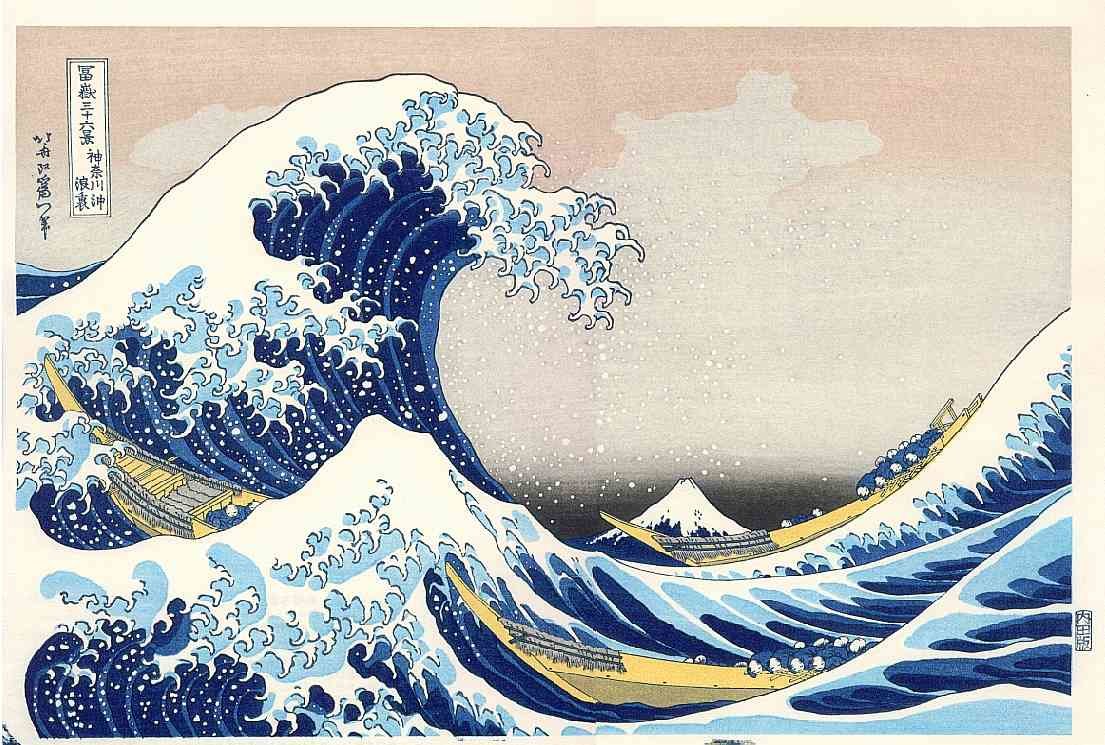
One of the topics discussed in the documentary was the occurrence of fractals in nature and art. Specifically, they highlighted the Japanese artist Hokusai. You are likely familiar with his famous painting of a giant wave and Mt. Fuji.

They identified the repeating curls of the wave within waves as a fractal. I also see the beginnings of a spiral. Spirals are fascinating patterns found throughout art, mythology, and nature. Much like fractals, they can be reduced to a mathematical formula (for more information on the math behind spirals, read about the golden ratio and the Fibonacci spiral).


One of the things I again find fascinating about spirals is their ability to grow. Like a forever ascending staircase reaching for the heavens, they wrap around themselves for eternity, growing always.

Spirals are enchanting. They capture your gaze, and enable amazing structural feats. Look to nature for examples.

The fern for instance-- I find the fern one of the most fascinating organisms on earth not only because of it's complicated life cycle, but also because it's design is so multi-dimensionally mathematical. It's a fractal, it's a branching tree, and it's a spiral at the fiddlehead phase.

And let us not forget DNA, the building block of life...The world's most important spiral.
Perhaps it is the importance of spirals in our life that has led to our fascination with them throughout time. Spirals are hugely symbolic and often revered to hold magical powers. Humans have included spirals in art since the earliest paintings.


I think that spirals have served as a representation of the universe as a whole, and therefore as systems thinking. Perhaps this is why spirals appear so powerful--to capture the essence of the shape of the universe in a pattern, a symbol.


Moving spirals have a meditative power, that I have often used to help calm my mind. Follow this link for an example-->http://www.youtube.com/watch?v=9GMtj_-3BOc&feature=related


How could spirals be incorporated into organizations?


Wednesday, February 2, 2011

My love/hate relationship with Fritjof Capra

Capra- Chapter 5.

I've read parts of this chapter 2-3 times. Something about the way Capra communicates just doesn't get fit with my learning style. I can't understand what he's trying to get at. I'm still upset about his comments about molecular biologists (which are heavy in the first part of Chapter 5), but for the sake of productivity I will not whine about them here---except to say, I feel Capra owes molecular biologists an apology. In Chapter 5, Capra gets defensive of systems thinking when a critique accuses the field of being vague. Capra claims that the critique is unjustified as systems thinking has advanced major understandings in the scientific understanding of life. I would say the same about molecular biology. In fact, I think it is much truer that systems thinking and molecular biology need each other, than it is that either is wrong. Two heads are better than one, they say.


Capra himself says in Chapter 5 that the synthesis of the study of structure and pattern is t”he key to a comprehensive theory of living systems.” Of course, he elevates the study of pattern over the study of structure, and doesn't pass up the opportunity to take another punch at “reductionist scientists.” I've met a lot of scientists. I haven't met a single one who wouldn't admit that the system as a whole affects all the parts within that system, and that life is fast and complicated. Perhaps Capra's criticism is a bit outdated? 99% of the scientists I know has gone out of their way to set up a collaboration, because they know that life is more complex than their particularly specialty and narrow focus.


Capra's irksome attacks on science aside, I have always been fascinated with the patterns of life, and I enjoyed the discussion about networks. The idea of self-organization was really interesting, especially the switch-board example (I like it when Capra uses examples, instead of resorting to language that is difficult for the uninitiated to understand). There are networks with rules at there nodes everywhere we look, although most often we don't know it. These self-organizing networks are what rule the world.


Capra discusses that “living organisms are able to maintain their processes under conditions of non-equilibrium.” This fact has enormous implications for ecology and evolution. I think it's important to note, however, that all living organisms and living systems have thresholds beyond which they have reached the point of no-return---death, then becomes the solution. If we don't know the threshold, then we shouldn't test how hard we can push the system from it's equilibrium. I've argued this EXACT point in a salmon population modeling course. The idea of life processes existing under non-equilibrium conditions is interesting from a sustainability perspective when the threshold is mentioned. It seems a little careless it was not. Perhaps I am missing Capra's point or perhaps it will be mentioned later.


I had a hard time understanding the parts about chemical self-organization and lasers (physics is NOT my strong point), but I definitely find the emergence of these patterns fascinating (I do better with larger structures, like crystals). I also find it fascinating that a period of instability always precedes the self-organization. Also, it makes sense to me that physics is non-linear. I can accept this idea easily.


Chapter 5 is an insanely long chapter, so for the sake of brevity, I will just post my superficial reactions to rest of the chapter.


*Hypercycles: Enzymatic feedback loops—much better studied zoomed out. I had to memorize these loops in college in my metabolic biochemistry course and it was really really difficulty. They are pretty awesome, however. I love the idea that “ the roots of life reach down into the realm of nonliving matter. Capra doesn't talk about an “RNA” world, but I think Eigen's initial ideas probably informed the “RNA world” hypothesis.


*Autopoiesis: This is another part of the book where I get lost--”living is a process of cognition.” I'm not really sure what the BIG DISCOVERY is here. I think the discovery meant that the system has internal and external factors influencing the feedback loop, and that your own perception helps shape your reality...but again, I was a confused by Capra's writing in this part. I am not sure I get it.


*Gaia hypothesis: Reading this books reminds me that I have taken for granted the things I believe to be true. OF COURSE the earth is self-regulating. I am grateful for the “revolutionaries” who drove this point home in the 60s and 70s. THE WORLD IS NOT FLAT.